





Follow-up email templates for freelancers and small businesses: proposal chasers, overdue invoice reminders, client win-back, abandoned cart, launch and post-purchase sequences — with the send day built into every email.
The email you did not send is the one that cost you the money.
Not the proposal — you wrote that. The three emails after it. The invoice reminder you drafted twice and deleted because the first version grovelled and the second sounded aggressive. The client who was booking every quarter until they were not, and the message you never sent because you could not think how to start it.
None of this is a writing problem. You know what needs saying. What stops the email is the tone: too soft and it reads as apologetic, too firm and it reads as an accusation, and rewriting the same paragraph four times at eleven at night is how it ends up unsent. So the work sits there, unpaid or unanswered, and the reason is a sentence you could not settle.
What is inside The Follow-Up Sequences
Ten sequences. Thirty-four emails. Every one finished. These are not prompts and there is no AI step — copy the email, fill the brackets, send it.
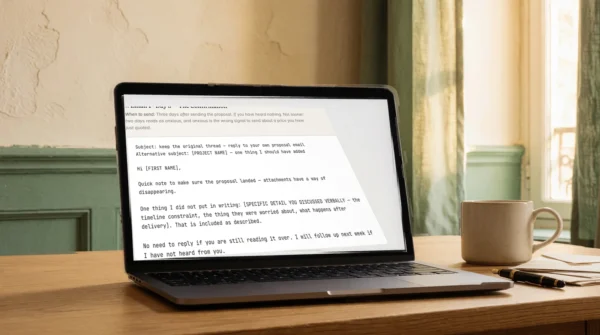
- The proposal that went quiet — four emails, Day 3 to Day 21, ending with the one that gets the answer either way.
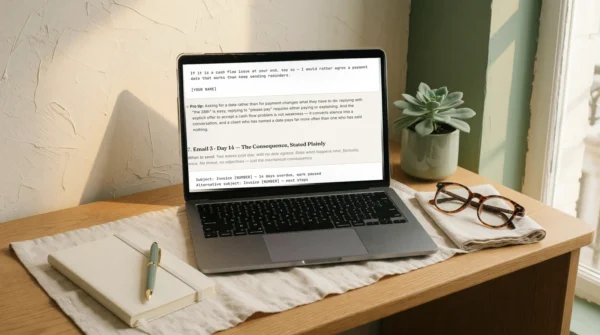
- The unpaid invoice — four emails, from the polite oversight assumption on Day 1 to a factual final notice at thirty days.
- The new client welcome — four emails covering the fortnight where doubt normally arrives.
- The abandoned cart — three emails, one objection each.
- The client who went quiet — three emails, starting with one that asks for nothing at all.
- The review request — two emails that stay on the right side of the FTC’s 2024 rule on reviews and testimonials.
- The launch — five emails from a week out to the close.
- After the purchase — four emails built to make a customer use what they bought.
- The price increase — two emails: the notice thirty days out, and the confirmation on the day.
- The end of the project — three emails, including the one at ninety days that books more work than any advertising you could buy for the same effort.
Every email carries the day to send it
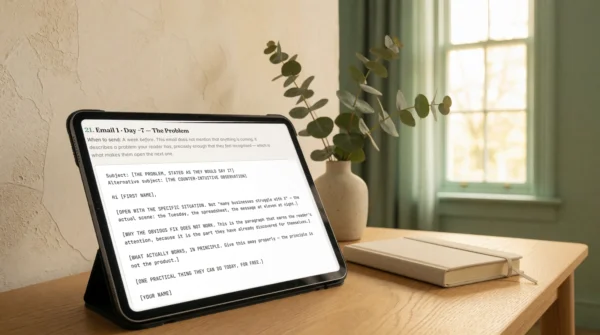
The spacing is the part most people get wrong, and it is the part that decides whether a sequence works. Two days is anxious. Three weeks is indifferent. Every email here is labelled — Day 0, Day 3, Day 12, Day 21 — with a line explaining what has changed in the reader’s head by then and why that email is written the way it is.
Each one also gives you two subject lines (one neutral, one direct) and a pro tip: the single detail that changes the reply rate, from replying inside the original thread rather than starting a new one, to naming the three possible objections instead of asking an open question.
Who The Follow-Up Sequences is for
Anyone who sends proposals and invoices without an accounts department behind them: freelancers, consultants, studios, trades, agencies, coaches, and small shops running their own email. If you have ever left a proposal unfollowed because you did not want to seem pushy, this pack was written for that specific hesitation.
What The Follow-Up Sequences is not
It is not an email marketing course, an automation platform, or a set of prompts to feed an AI. There is no software to connect and nothing to configure. It is 33 pages of finished emails with 281 blanks in square brackets waiting for your details, and it works the same whether you send from Gmail, Outlook, or a tool with a thousand features you have never opened.
It also stops where it should. The unpaid invoice sequence ends at a firm, factual final notice — what comes after that depends on your country and your contract, and nothing here is legal advice.
Included with The Follow-Up Sequences
- The Follow-Up Sequences — 33-page PDF, 10 sequences, 34 emails, designed to be read on screen or printed.
- Two subject lines and one pro tip for every email.
- A send-day schedule built into each sequence.
- Free updates to this edition, sent to the email you buy with.
Instant download. One-time purchase, no subscription. Licensed for use in your own business and for clients whose email you write.
Reviews
There are no reviews yet.